This is a question I see a lot, and the honest answer is: it depends on your state, but practically speaking, yes — you want one.
Most states do not require you to physically hand over a detailed driving log to the DMV when your teen takes the road test. What most states require is that a parent or guardian sign a form certifying that the supervised driving hours are complete. Some states ask for the totals; some states ask for nothing beyond the signature.
That gap between "the DMV doesn't ask" and "the parent certifies under penalty of perjury" is the entire reason families benefit from keeping a log even when it's not formally required.
What the certification actually means
When a parent signs a permit-hour certification, they're attesting that the driving happened. The form usually has space for total hours and night hours, sometimes broken down by category. The parent's signature is legally a statement that those numbers are accurate.
Most parents are good-faith certifiers. They believe their teen drove the hours. But "believing" and "having a record" are different things, and the difference matters if the road test goes poorly, if there's an incident shortly after licensing, or if any question ever comes up about whether the supervised hours were really completed as certified.
A simple, dated log resolves all of that. It's not for the DMV. It's for the parent's own peace of mind, and the teen's protection later.
The road test itself
The road test does not check your log. Examiners check whether the teen can actually drive — parking, lane changes, turns, mirror checks, intersections, freeway entry where applicable. If your teen has genuinely done the supervised hours, they show up to the test prepared, and the log is incidental.
The danger sign is when families realize, the week before the test, that they don't actually know how many hours have been completed. That's when families start estimating in the parent's favor, signing certifications they're not sure about, and rushing to make up hours that may or may not be needed. A clean log eliminates that scramble.
What a useful log contains
A good driving log captures the date of each drive, the start and end times (or start time and duration), an indication of whether it was day or night driving, the road type, and ideally a quick notation if anything notable happened (first highway merge, first parallel parking, that kind of thing).
The key word is "useful," not "exhaustive." A log that's too detailed becomes a burden the teen stops maintaining. A log that's too sparse stops being useful when you actually need to reference it.
Why we built Clocked around this exact problem
Clocked exists because supervised driving logs are conceptually simple — drives in, hours out, certify and submit — and practically broken. I built it after my sisters cycled through their permits with mismatched paper logs, half-filled spreadsheets, and apps designed for fleet drivers rather than teen permit holders.
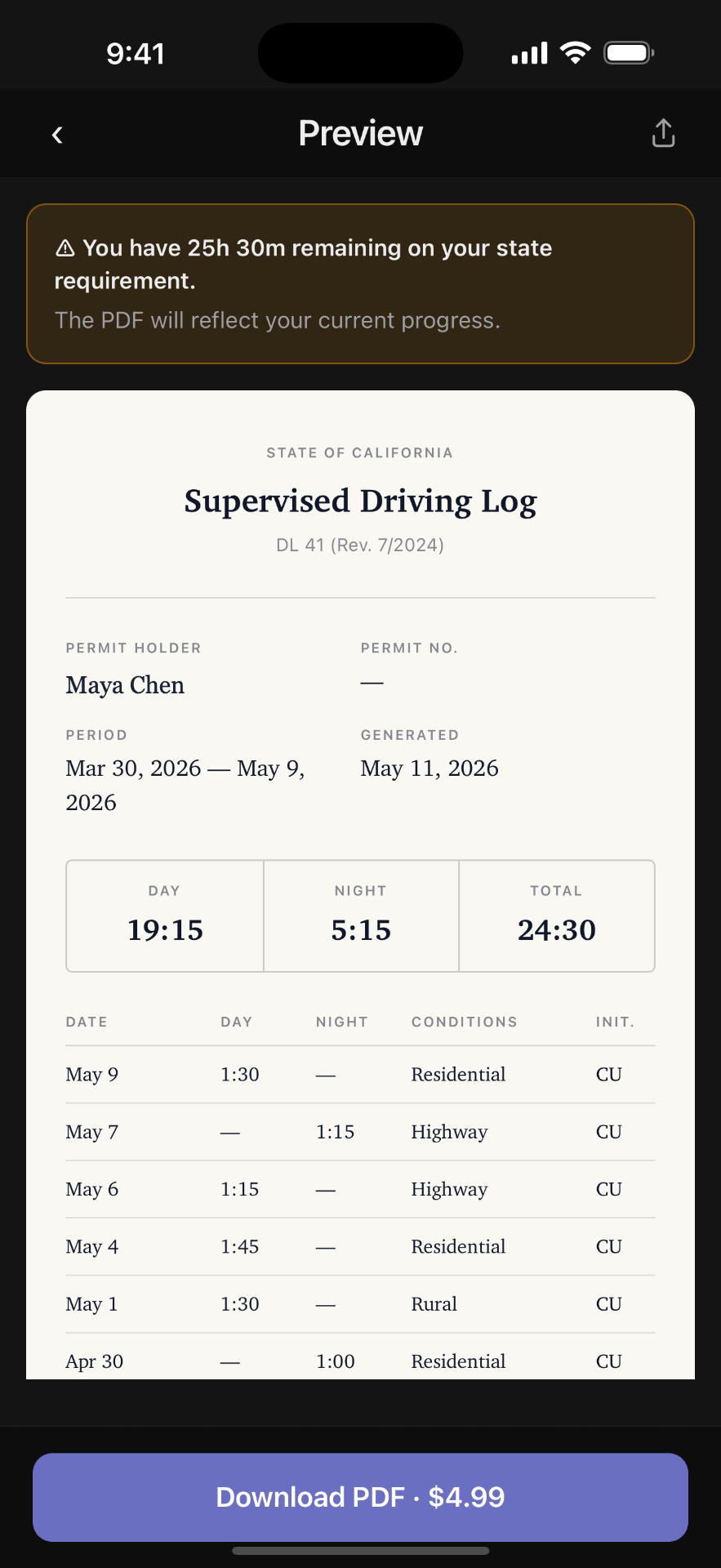
The export from Clocked is built specifically to look like a DMV record: state header, permit holder name, period covered, total day/night/total hours, and a chronological table of each drive. If your state ever does ask, or if questions come up later, you have an actual document. You can see what the export looks like on our home page, or

Final thoughts
The right answer to "do I need a driving log" is: maybe not by your state's letter of the law, but yes by any reasonable standard of care. Parents are certifying real hours. Teens are building toward a license that comes with real responsibility. A clean, dated record protects both sides, costs nothing in time once it becomes habit, and turns the certification into a non-event instead of a stressor.
Use a notebook, a spreadsheet, a dedicated app — the specific tool matters less than the discipline of recording every drive when it happens.
Internal links: