If you're a teen working toward a California driver's license — or a parent helping one — the supervised driving requirement is the longest part of the process. Fifty hours sounds like a lot, and tracking them across months of practice trips is where most families lose ground.
This guide covers what California actually requires, what the DMV will ask you to certify, and the specific things that trip families up along the way.
What California requires
Teens under 18 must complete 50 hours of supervised driving before they can take the road test. 10 of those hours must be at night, defined by the DMV as the period between sunset and sunrise. The supervising adult must be a licensed California driver age 25 or older, riding in the front passenger seat.
In addition to the driving hours, teens must complete driver's education and driver's training, and they must hold their learner's permit for at least six months before taking the road test.
What the DMV actually checks
Here's the part that confuses many families: the California DMV does not require you to submit a detailed driving log when your teen takes the road test. What they do require is that a parent or guardian sign the DL 400 form (Behind-the-Wheel Driving Instruction), certifying that the 50 hours are complete.
Because the form is a certification rather than a submission, many parents skip the detailed tracking entirely — and then realize too late that they don't actually know how many hours their teen has driven. That's where the trouble usually starts.
Why night hours get missed
The 10 night-hour requirement is the most commonly undercounted part of the certification. A drive that starts at 6:30 PM in November might be fully a night drive; the same drive in June is mostly daytime. Most families either guess or skip the classification entirely.
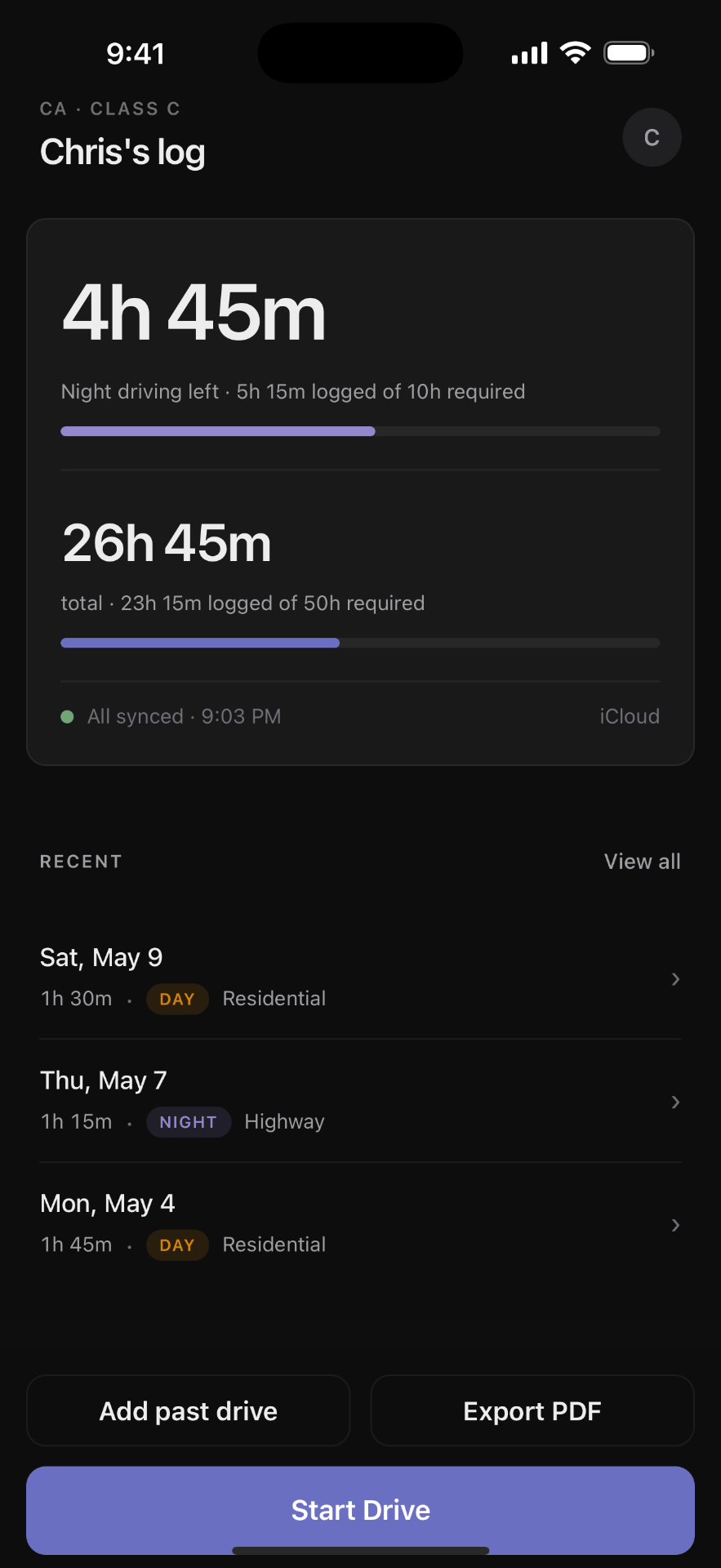
This is one of the specific things Clocked solves. The app uses your local sunset and sunrise times to classify each drive automatically, so the day/night split is correct based on the actual sun, not a rough estimate. California's 10-hour night requirement shows up as its own progress bar in the app, separate from the 50-hour total.
Where families lose hours
Across hundreds of permit cycles, the same patterns repeat: a drive happens but never gets written down, a parent jots a time on a sticky note that disappears, a teen tries to reconstruct a week's worth of practice from memory the night before the road test. Paper logs work in principle and fail in practice, because they require perfect discipline over six or more months.
The most reliable way to certify the 50 hours honestly is to log every drive immediately, in something that won't get lost. That can be a notebook you keep in the car, a shared spreadsheet, or a dedicated app. The format matters less than the consistency.
A short note on why we built Clocked
I built Clocked after watching multiple sisters work through their permits and lose hours to bad paperwork and apps that weren't built for this. Tracking 50 hours of supervised driving should not require a spreadsheet you maintain yourself or a paper log you have to find at the bottom of a glovebox. Clocked is built specifically for the permit-hour workflow — California's exact rules, automatic day/night classification, a clean PDF export you can save for your records, and local-first saving so a drive never disappears because you didn't have signal.
If you're working through the California permit process, you can

Tips that actually help
Spread practice across many months rather than cramming. Drive in conditions that aren't just clear weather and empty streets — highways, rain when it's safe, after-dark practice in neighborhoods you know. Track immediately after each drive, not from memory at the end of the week. And prioritize getting the 10 night hours done early; they're the most likely to be missed.
The permit period is long. The road test goes faster if the log behind it is clean.
Internal links: